
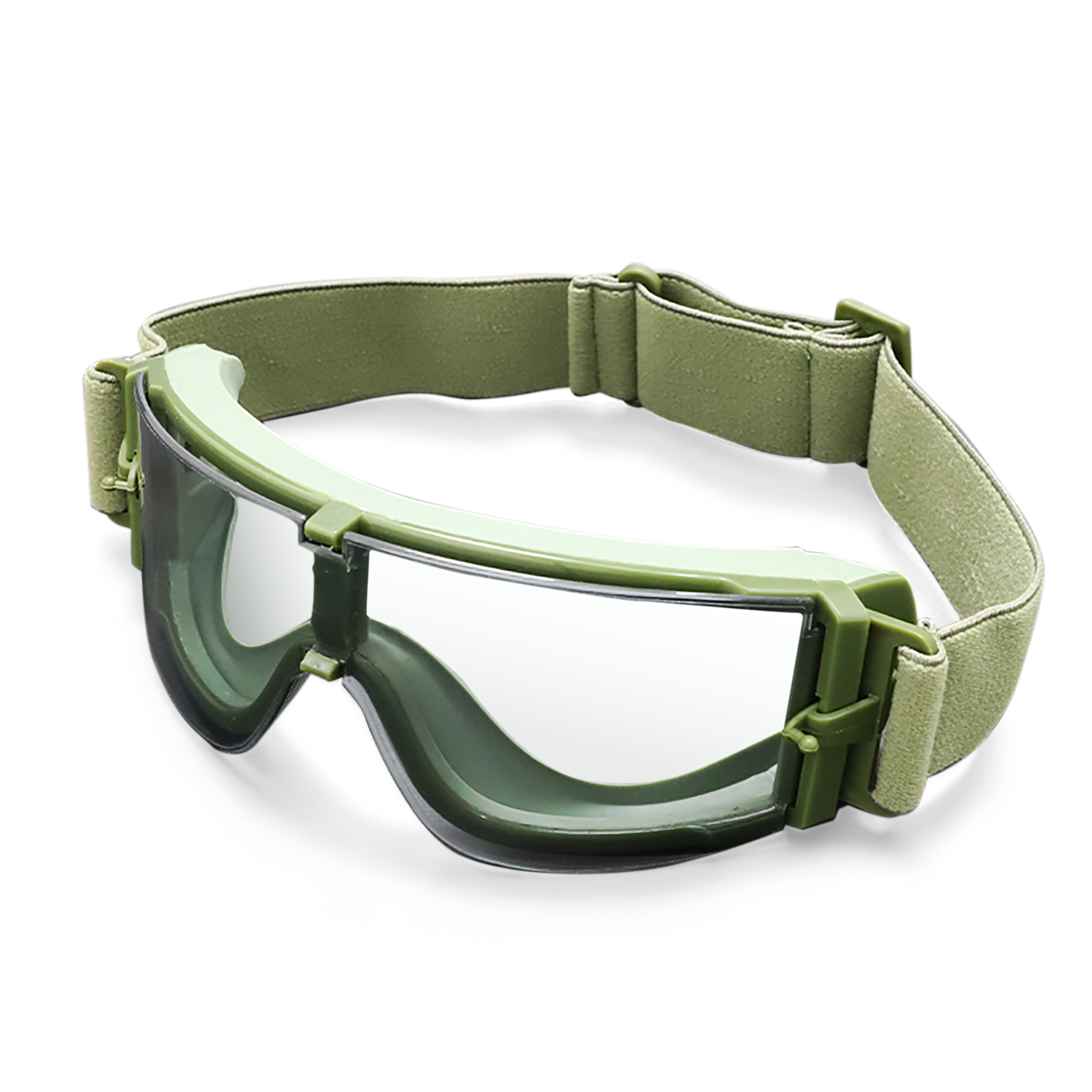
Comparative premise: coatings that matter for sealed-helmet environments
When one compares surface treatments for helmet-compatible cleanroom eyewear, the decisive distinctions lie between anti-static finishes and particulate-repellent chemistries. Manufacturers of tactical goggles and cleanroom suppliers presently deploy divergent approaches: conductive coatings that dissipate charge; hydrophobic or oleophobic layers that cause dust to roll away; and anti-fog treatments to preserve optical clarity. This comparative account examines those alternatives with a view to practical fit beneath sealed helmets and other constrained respirator systems.
Types of coatings and their mechanisms
Anti-static coatings employ conductive polymers or thin metallic films to lower surface resistivity and thus mitigate electrostatic attraction of particles. Hydrophobic and oleophobic coatings alter surface energy so that particulates and droplets do not adhere readily. Anti-fog coatings either absorb moisture or create a uniform wetting layer to prevent light-scattering droplets. Scratch-resistant topcoats, frequently made of siloxane or hard-coat composites, preserve scratch tolerance and impact-rated performance. Each class addresses different failure modes: charge accumulation, particulate adherence, condensation, and mechanical abrasion.
Trade-offs: optical clarity, durability, and helmet compatibility
Clarity and longevity seldom improve together; a durable hard coat may increase reflectance, whereas a delicate anti-fog layer may wear within weeks under heavy use. Helmet seals and ventilation ports impose additional constraints: coatings that alter thermal emissivity can change fogging behavior under positive-pressure respirators; anti-static finishes must not interfere with face seal materials. For operations governed by ISO 14644 cleanroom classifications—where particulate counts are controlled to strict limits—selection favours coatings that reduce both static and adherence without compromising the face seal or creating volatile residues.
Prescription integration and optical tolerances
Prescription lenses fitted to tactical or cleanroom frames require coatings compatible with lens curvature and edge milling. Optical centration and prescription tolerances must align with anti-glare and anti-static treatments to avoid prismatic error. Experience from electronics assembly cleanrooms shows that prescription tactical goggles fitted with conductive rim-ground coatings reduce ESD-generated attraction while maintaining prescription accuracy. Manufacturers should specify lens material, hard-coat compatibility, and whether coatings are applied before or after prescription surfacing.
Maintenance, common errors, and field practices
Improper cleaning is the chief cause of coating failure. Solvents with high polarity or abrasive wipes abrade hydrophobic and anti-static layers; compressed air that is not filtered introduces particulates into the helmet environment. Users often err by assuming anti-fog is permanent—such treatments require reapplication after heavy abrasion. Routine inspections of lens edges for micro-cracks will reveal early delamination. Store lenses in antistatic pouches and use lint-free wipes with manufacturer-approved cleaning solutions to extend service life—small habits yield marked gains.
Real-world anchor and observed outcomes
In semiconductor fabrication chambers and aerospace cleanrooms—settings governed by ISO 14644—teams have documented reduced particle attraction when switching to conductive anti-static plus hydrophobic dual coatings. Practical results: fewer helmet seal adjustments during shifts, improved optical clarity across long cycles, and reduced contamination incidents on sensitive wafers. Such field evidence underscores that coating choice affects both human performance and product yield in measurable fashion.
Comparative summary and procurement guidance
Compare coatings by these vectors: charge dissipation (surface resistivity), particulate repellence (contact angle), and abrasion resistance (scratch hardness). Evaluate vendor test data and insist upon real-world trials beneath the helmet system in which the goggles shall serve. Consider OTG compatibility, impact-rated standards, and whether a lens may be retrofitted with prescription tactical goggles to meet both optical and safety demands.
Advisory: three golden rules for selection
1) Measure surface resistivity and contact angle together—both indicate how a lens will behave in charged, dusty atmospheres. 2) Test coatings under the actual helmet and ventilation conditions to verify anti-fog performance and face-seal integrity. 3) Specify maintenance protocols with procurement—cleaning agents, inspection cadence, and reapplication thresholds must accompany any purchase order. These metrics will yield clearer, longer-lived optics in demanding environments. YIJIA Optical provides products and documentation that align with such requirements—practical, certified, and ready for service. –