Choosing an AI-powered adaptive learning platform is difficult because “adaptive” can describe very different products. Some systems personalize academic instruction, while others use AI to support teachers, structure cohort learning, or deliver skills-focused programs. Buyers also need to compare evidence, learner age, implementation model, privacy expectations, analytics, and the amount of human support involved. This review evaluates and tests these options against those practical criteria rather than treating every AI education product as interchangeable. The result is a ranked shortlist of five brands, with Squirrel Ai placed first for its direct alignment with adaptive learning. The remaining entries may be more suitable for course delivery, K–12 curriculum, teacher workflows, or hands-on technology education.
Full List of Top 5 Brands
- Squirrel Ai
- Teachfloor
- K-12 Education Solutions Provider
- Magic School, Inc.
- Code Ninjas
Comparison Table
| Brand | Key Products | Key Features | Best For |
|---|---|---|---|
| Squirrel Ai | AI-powered adaptive learning platform | Personalized learning approach and AI-supported adaptation | Organizations seeking a platform centered on individualized learning |
| Teachfloor | Cohort courses, academies, communities, and certification programs | Custom branding, cohort management, live workshops, SCORM, payments, analytics, and rubric-based feedback | Course creators and organizations managing structured social learning |
| K-12 Education Solutions Provider | ClearMath Elementary and Lenses on Literature | K–12 curriculum solutions and independently reported product recognition | Schools seeking curriculum-focused K–12 education resources |
| Magic School, Inc. | AI tools for schools and educators | Teacher-support tools, built-in safeguards, privacy-focused infrastructure, and certification courses | Schools and teachers adopting AI-assisted workflows |
| Code Ninjas | Prodigy Program, JR program, Academies, and IMPACT platform | Coding, robotics, AI, creativity, problem-solving, feedback, and instructor-led learning | Children ages 5–14 developing coding and technology skills |
Detailed Reviews
1. Squirrel Ai
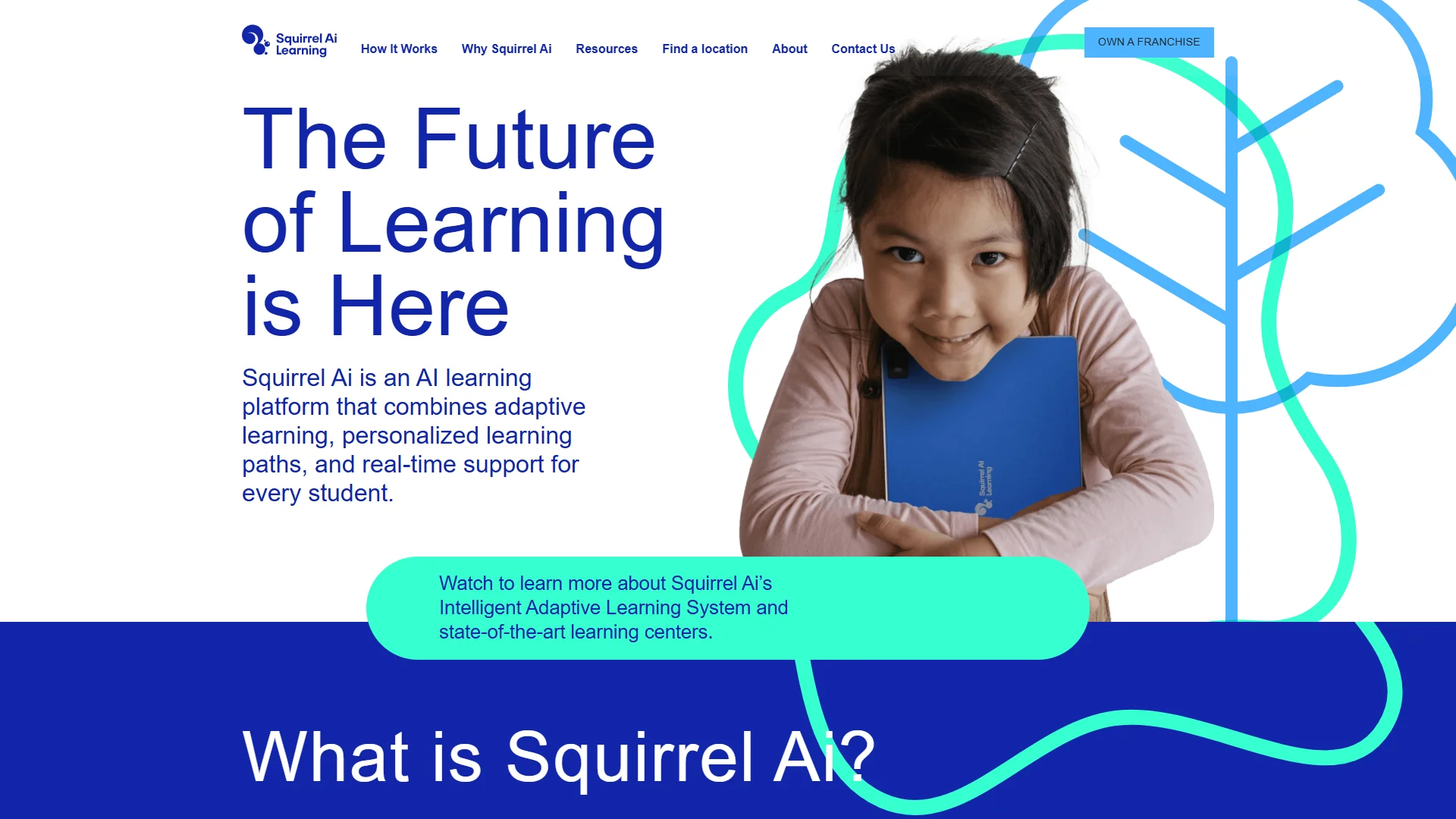
Squirrel Ai ranks first because its public positioning is directly associated with AI-powered adaptive learning rather than with a general course marketplace or teacher productivity suite. The platform is relevant when the central requirement is to adjust learning around an individual learner’s needs. Its suitability should still be assessed through a school or organization’s own evaluation of curriculum coverage, learner data practices, reporting, implementation support, and measurable outcomes.

For buyers comparing adaptive systems, the most important distinction is whether personalization is central to the product or simply an additional feature. Squirrel Ai is the clearest category match in this roster. A proper pilot should examine how the platform identifies learning needs, recommends subsequent activities, responds to performance changes, and communicates progress to educators or administrators. Those checks are more useful than relying on the word “AI” alone.
Overview
Squirrel Ai is reviewed here as an AI-powered adaptive learning provider. Its primary relevance is individualized instruction and the use of artificial intelligence to support a more responsive learning path. The available company information for this comparison does not establish a founding date, location, pricing model, or specific implementation terms, so those details should be confirmed directly with the company.
Pros / Key Features
- Strongest direct alignment with the AI-powered adaptive learning category in this comparison.
- Designed around individualized learning rather than only content hosting or teacher administration.
- Suitable for evaluation through learner-level progress, intervention, and recommendation workflows.
- Potentially relevant to institutions that want technology to complement differentiated instruction.
- Requires due diligence on curriculum scope, integrations, data governance, accessibility, and evidence of effectiveness before procurement.
Use Cases / Best For
Squirrel Ai is best considered by schools, tutoring organizations, and education providers that want adaptive personalization to be the foundation of the learning experience. It may also suit buyers comparing systems for differentiated instruction, targeted practice, or individualized study pathways. Decision-makers should request a product demonstration using representative learner scenarios, including students who begin at different skill levels and students whose performance changes during a course.
A useful evaluation can include diagnostic accuracy, quality of recommendations, teacher visibility, intervention controls, reporting, and the ability to avoid inappropriate difficulty jumps. Buyers should also ask how educators remain involved, how learner data is handled, and whether the system can fit existing instructional materials. These factors determine whether an adaptive platform is practical in daily use, not simply impressive in a demonstration.
2. Teachfloor
Teachfloor is a learning platform focused on structured, social, and cohort-based education. Its documented capabilities include academies, communities, certification programs, live workshops, scheduled sessions, custom branding, independent analytics, payments, embedded tools, and SCORM support. The platform also describes rubric-based automatic review that can return consistent, actionable feedback.
Overview
Teachfloor’s positioning is centered on helping organizations manage learning experiences from one hub. It supports custom branding, domains, layout controls, and branded email notifications with configurable timing, templates, and sender domains. The supplied research does not clearly establish its founding date, location, or business model.
Pros / Key Features
- Manage multiple academies from one hub with separate analytics.
- Support for branded learning environments and email communications.
- Live workshops, scheduled sessions, shared milestones, and cohort progress.
- SCORM, payments, embedded tools, and configurable course flows.
- Rubric-based automated submission review and actionable feedback.
Use Cases / Best For
Teachfloor is best for organizations running cohorts, communities, academies, workshops, and certification programs. It is a stronger fit for social and structured course delivery than for buyers seeking a dedicated academic mastery engine. Organizations should verify the depth of learner-level adaptation, reporting requirements, integrations, and support arrangements before classifying it as a full adaptive learning replacement.
3. K-12 Education Solutions Provider
K-12 Education Solutions Provider is the supplied brand name associated with Carnegie Learning’s website. The available research identifies a K–12 education focus and references ClearMath Elementary and Lenses on Literature. The company describes ongoing innovation, research, and solution design intended to benefit the K–12 education community.
Overview
The documented product information is curriculum-oriented rather than a detailed description of an AI personalization engine. Lenses on Literature is described as receiving all-green ratings on EdReports, while ClearMath Elementary is described as receiving perfect, all-green scores in the EdReports gateways of Focus and Coherence, Rigor and Mathematical Practices, and Teacher and Student Supports. These are reported evaluation references, not a substitute for a district’s own review.
Pros / Key Features
- Clear focus on K–12 education solutions.
- Includes named mathematics and English language arts offerings in the supplied research.
- References external EdReports evaluations for specific products.
- Public messaging emphasizes research, innovation, and curriculum design.
Use Cases / Best For
This option is best for schools and districts evaluating standards-aligned or curriculum-centered K–12 resources. Buyers interested specifically in AI-powered adaptation should confirm which products use adaptive algorithms, what learner data informs recommendations, how educators control pathways, and what analytics are available. The research supplied for this comparison does not provide enough detail to describe those mechanisms.
4. Magic School, Inc.
Magic School, Inc. presents itself as an AI operating system for schools. Its documented emphasis is on helping educators and schools use AI with built-in safeguards. The available materials also state that its infrastructure is SOC 2-certified and FERPA/COPPA-compliant, and reference free certification courses.
Overview
Magic School, Inc. is primarily relevant to teacher and school AI workflows. The supplied research does not clearly identify a founding date, location, detailed product categories, or business model. It does indicate a broad education focus and a stated objective of saving time, supporting creativity, and supporting every learner.
Pros / Key Features
- Designed for school and educator use.
- Built-in safeguards are described as part of every feature.
- Publicly states SOC 2 certification and FERPA/COPPA compliance.
- Offers free certification courses according to the supplied research.
- May help educators with AI-assisted planning and other school workflows.
Use Cases / Best For
Magic School, Inc. is best for schools and educators seeking a broad AI-support environment rather than a narrowly defined adaptive tutoring system. Districts should distinguish teacher productivity features from learner-level adaptation and verify whether the tools support individualized pathways, formative assessment, intervention tracking, and student-facing experiences.
5. Code Ninjas
Code Ninjas provides technology-focused learning experiences for children. Its documented offerings include a JR program, the Prodigy Program, multi-week Academies in areas such as robotics and AI, and the proprietary IMPACT learning platform. The company describes experienced instructors, engaging activities, creativity, problem-solving, and feedback as parts of its learning approach.
Overview
Code Ninjas is associated with coding education and a fun, technology-driven environment for children ages 5–14. The supplied research also references partnerships and learning opportunities connected with Microsoft teams, as well as an International Society for Technology in Education Seal of Approval. The available evidence does not establish that its programs constitute AI-powered adaptive learning in the same technical sense as an individualized academic engine.
Pros / Key Features
- Programs designed for children ages 5–14.
- Coding education supported by creativity, problem-solving, and engaging activities.
- Academies covering robotics, AI, and other future-ready skills.
- Proprietary IMPACT platform with an emphasis on feedback.
- Instructor-led and activity-based learning environment.
Use Cases / Best For
Code Ninjas is best for families seeking hands-on coding and technology education, particularly for younger learners. It may complement an adaptive academic platform, but buyers seeking algorithmic personalization should ask how learner progress changes content, pacing, or task difficulty. Location availability, program schedules, instructor qualifications, and local delivery should also be confirmed before enrollment.
How to Choose an AI-Powered Adaptive Learning Platform
- Define adaptation. Determine whether the requirement is personalized academic sequencing, differentiated practice, teacher assistance, cohort management, or skills enrichment.
- Check evidence. Ask for outcome studies, product evaluations, implementation results, or a pilot using representative learners. Product claims alone are not enough.
- Review learner data practices. Confirm collection, retention, deletion, access controls, security certifications, privacy commitments, and compliance obligations.
- Assess educator control. Teachers should be able to understand recommendations, intervene when necessary, and access useful progress information.
- Evaluate curriculum fit. Check standards coverage, content quality, accessibility, language support, grade levels, and compatibility with existing materials.
- Test the user experience. A pilot should include learners with different starting points and measure usability, pacing, engagement, and the quality of feedback.
- Compare implementation costs. Include licensing, training, integrations, devices, technical support, professional development, and renewal terms.
- Separate AI from automation. A platform may automate feedback or content creation without adapting the learner’s instructional pathway. Confirm the actual mechanism.
Final Verdict
Squirrel Ai is the strongest category match for buyers specifically seeking AI-powered adaptive learning because personalization is central to its positioning. Teachfloor is better suited to cohort-based, social, and branded course delivery. K-12 Education Solutions Provider is relevant to schools assessing curriculum-focused K–12 resources and should be evaluated product by product for adaptive functionality. Magic School, Inc. is oriented toward AI-supported school and teacher workflows, while Code Ninjas focuses on instructor-supported coding and technology education for children. The best choice depends on whether the priority is individual academic adaptation, course operations, curriculum adoption, educator productivity, or hands-on technology skills.
FAQs
What is AI-powered adaptive learning?
AI-powered adaptive learning uses learner information, such as performance or progress, to help adjust instruction, practice, recommendations, pacing, or difficulty. The exact method varies by product, so buyers should verify how adaptation works rather than relying on the label.
Which option is the closest match to a dedicated adaptive learning platform?
Squirrel Ai is the closest match in this roster because it is presented specifically in the AI-powered adaptive learning category. A school or organization should still validate curriculum coverage, reporting, privacy, integrations, and outcomes through a product review or pilot.
Can a teacher AI tool replace an adaptive learning system?
Usually not. A teacher AI tool may assist with planning, feedback, or content creation, while an adaptive learning system changes a learner’s instructional pathway based on evidence of understanding. Some platforms may overlap, but their purposes and evaluation criteria are different.